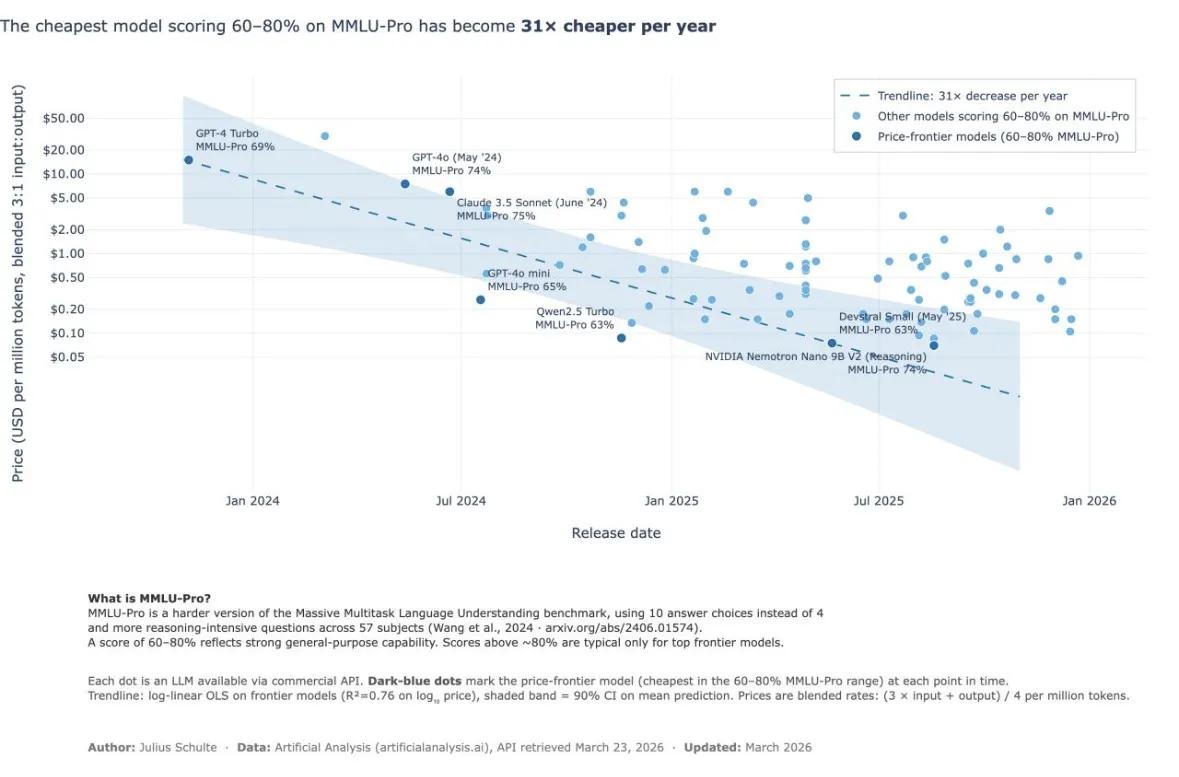
400× price collapse in two years. Capability steady. The frontier model cost curve looks like a single story of relentless deflation.
It's actually a divergence in disguise.
In my article, I argued that the demand for AI agents has two regions. Borrowing the logic here:
For substitution demand (i.e., tasks with human alternatives), the collapse is exactly what it appears to be: commoditization. Margins compress because the ceiling is the wage, and the wage is falling. Every provider races to the same floor.
For frontier work, tasks with no human equivalent at any price, the same collapse triggers the opposite. This is Jevons' paradox in real time: when a resource gets dramatically cheaper, consumption doesn't fall proportionally, it explodes. When Victorian coal got more efficient, Britain burned more of it, not less. The efficiency unlocked uses nobody had bothered attempting before. Drawing parallels from history, inference at $0.05 per million tokens doesn't mean smaller compute bills. It means use cases that couldn't survive an ROI conversation at $20 suddenly pencil out. Monitoring, personalization, and simulation at scales that felt economically absurd last quarter have become viable this one.
This one cost curve tells us about two demand structures. Though the graph can't tell you which market you're in, your pricing power can.
The macroeconomic read is uncomfortable either way. Substitution deflation transmits directly to labor: cheaper agents, cheaper humans, lower wage ceilings, self-reinforcing. In frontier markets, value concentrates among firms with proprietary data and infrastructure scale, the inputs that stay scarce when compute doesn't. The middle gets squeezed from both directions.