CHROs planning workforce transitions around these numbers are building on sand
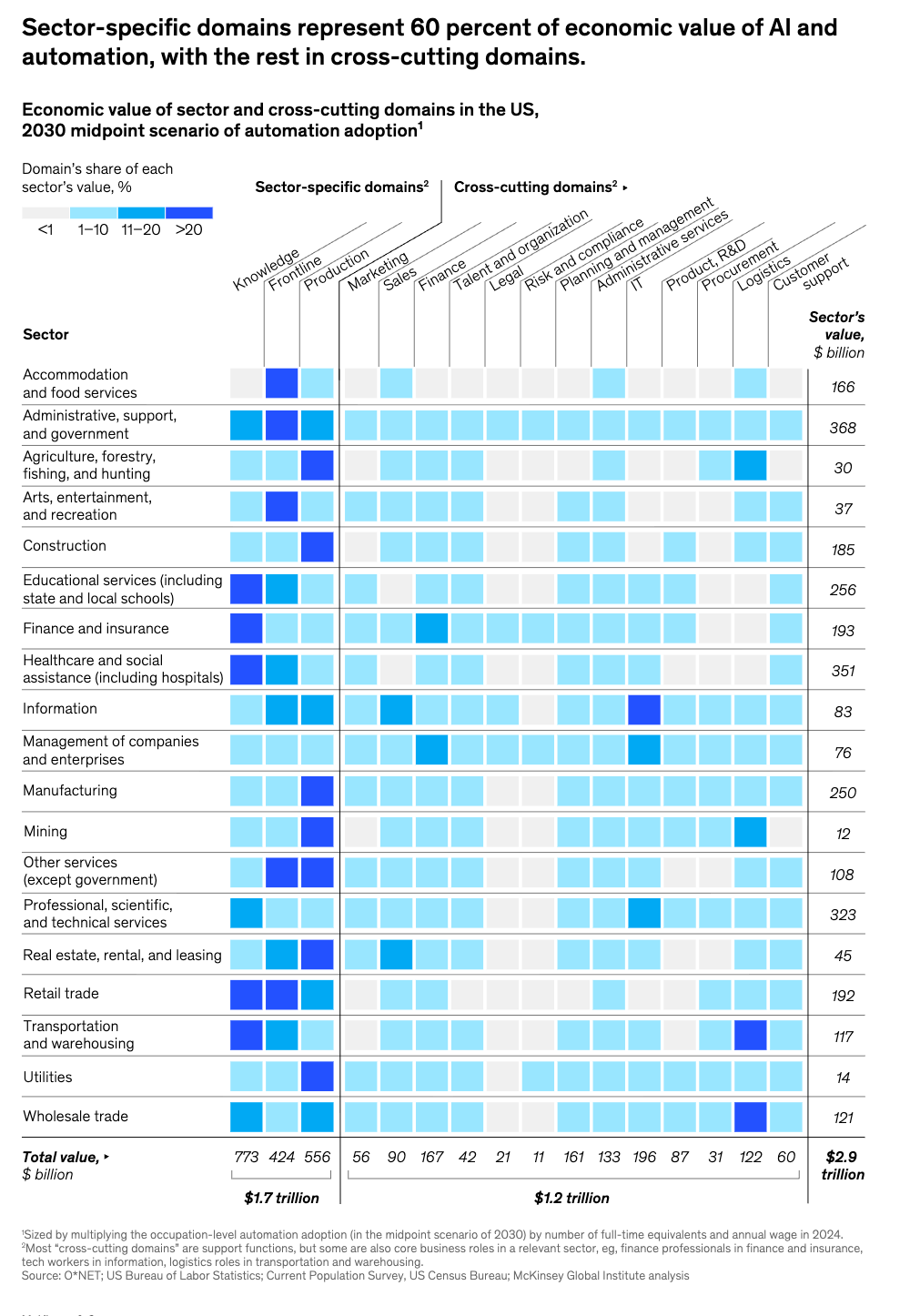
McKinsey's new automation forecast puts $2.9 trillion economic value in US work hours that could be automated by 2030.
It is a striking number.
It’s also the wrong number to plan around.
The methodology prices what AI can theoretically perform, not what organizations will operationally adopt. In reality, only 5% of firms reach full-scale, customized implementation that drives significant value. MIT analysis offers a sharper lens: only 23% of wages for AI-exposed tasks are cost-effective to automate when accounting for implementation, integration, and maintenance costs that capacity models explicitly exclude. The remaining 77% fails basic ROI tests once you move from benchmark to budget line.
CHROs planning workforce transitions around the $2.9 trillion figures or alike are conflating exposure with transformation. The pattern holds across high-value professional work for reasons I discussed in why AI adoption stalled - verification costs, liability exposure, workflow bundling, and credentialing constraints that task-level benchmarks were never designed to capture. A legal AI that drafts contracts brilliantly still requires partner-level review - costs that rarely appear in automation math but dominate actual deployment decisions.
The useful planning question may be not “how much work can AI perform?” but “where does verification or integration cost less than the work itself?”
Capacity is not destiny.